The Visions of Pablo Cesar Amaringo
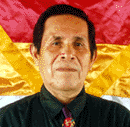 Pablo Amaringo, the seventh of thirteen children, was born in
1943 in Puerto Libertad, a small settlement near the town of Tamanco
in Peru. His parents were small farmers. While Quechua was the
mother tongue of his parents, they raised their children to speak
Spanish. Many of Pablo's ancestors were healers and shamans. Pablo
had completed only two years of schooling when his father abandoned
the family. They lost their farm and moved to Pucallpa. After
two more years of school, Pablo was forced to work to help support
his family. At 15, he worked on the docks in Pucallpa. After falling
critically ill, and with his family in extreme poverty, he began
to draw. He found that he could create bank notes using brushes
and Chinese ink. Arrested for counterfeiting, he escaped from
jail and fled to Brazil, where he worked for almost two years.
He returned to the Peruvian jungle, where he was cured of his
heart trouble by a ayahuasquero, or vegetalist shaman. Arrested
again for his past crime, he spent several months in jail and
was released in 1969. Soon after, Pablo was taught the mysteries
of healing by a forest woman who appeared to him in dreams. He
practised vegetalismo from 1970 to1976, travelling throughout
the Peruvian Amazon. Plunging deeper and deeper into the power
of Ayahuasca, or yaj?, an herbal concoction widely used in a shamanic
context among the Indian and mestizo population of the upper Amazon,
he became tortured by the spirit world. After fighting, and being
injured by sorcerers and spirits, he decided to abandon shamanic
practices and forsake Ayahuasca. He began to paint, interpreting
the other worlds of his experience in his art, and working for
preservation of Amazonian environment and culture.
Pablo Amaringo, the seventh of thirteen children, was born in
1943 in Puerto Libertad, a small settlement near the town of Tamanco
in Peru. His parents were small farmers. While Quechua was the
mother tongue of his parents, they raised their children to speak
Spanish. Many of Pablo's ancestors were healers and shamans. Pablo
had completed only two years of schooling when his father abandoned
the family. They lost their farm and moved to Pucallpa. After
two more years of school, Pablo was forced to work to help support
his family. At 15, he worked on the docks in Pucallpa. After falling
critically ill, and with his family in extreme poverty, he began
to draw. He found that he could create bank notes using brushes
and Chinese ink. Arrested for counterfeiting, he escaped from
jail and fled to Brazil, where he worked for almost two years.
He returned to the Peruvian jungle, where he was cured of his
heart trouble by a ayahuasquero, or vegetalist shaman. Arrested
again for his past crime, he spent several months in jail and
was released in 1969. Soon after, Pablo was taught the mysteries
of healing by a forest woman who appeared to him in dreams. He
practised vegetalismo from 1970 to1976, travelling throughout
the Peruvian Amazon. Plunging deeper and deeper into the power
of Ayahuasca, or yaj?, an herbal concoction widely used in a shamanic
context among the Indian and mestizo population of the upper Amazon,
he became tortured by the spirit world. After fighting, and being
injured by sorcerers and spirits, he decided to abandon shamanic
practices and forsake Ayahuasca. He began to paint, interpreting
the other worlds of his experience in his art, and working for
preservation of Amazonian environment and culture.
In 1988, Pablo founded the Usko-Ayar school, where he teaches
his students to visualize internally what they are going to paint,
in the same way that he does himself. "The school's purpose is
well defined: it is a tool for the conservation of the Amazonian
environment and culture. By observing and depicting nature, people
- especially young children - become more aware of its beauty
and richness, and they learn to respect it. In addition, the students
hope that their paintings will inspire other people to share similar
attitudes of appreciation and reverence."* Pablo feels that he
has a mission, which is to show through his own paintings glimpses
of other dimensions. Language, he says, is an imperfect means
of communication. The spirits do not talk, but express themselves
through images.
In 1992, Pablo was presented the prestigious Global 500 Peace
Prize from the United Nations Environmental program, joining Jacques
Cousteau, Chico Mendez, and Jimmy Carter, among many others, as
a true hero of the environmental movement. You can read more about
Pablo's introduction to and slow education in the way of the shaman
in the book Ayahuasca Visions - The Religious Iconography of a
Peruvian Shaman by Luis Eduardo Luna - ©1991, 1993, North Atlantic
Books, Berkeley, CA, sponsored by The Society for the Study of
Native Arts and Sciences, and from which this biography is summarized.
In addition, the photograph of Pablo above is copyrighted by Dr.
Luna - no unauthorized reproduction may be made of this text or
images.